Every few centuries, humanity enters a transformative period where technology profoundly disrupts how people work. From the steam engines that powered the Industrial Revolution to today’s AI algorithms, each disruption has rewritten economic, social, and cultural narratives. But what is often overlooked is the silent thread binding these shifts: technology changes who controls labor, how labor is perceived, and where the power resides within society.
Consider the Industrial Revolution. It’s frequently portrayed as a simple shift from farm to factory, but its impacts were far more profound. Mechanization did not merely boost production; it centralized power. It pulled labor away from local, family-centered trades and placed it under the control of industrial magnates who owned the factories, dictating the terms of work. This centralization introduced the concept of “workers” as a distinct class—a label that didn’t exist in quite the same way when most people worked for themselves or their communities.
AI doesn’t just automate; it learns.
Now, as AI sweeps through sectors from finance to manufacturing, we’re seeing a similar centralizing force, but with a modern twist: those who control the AI, the data, and the algorithms control not only production but also decision-making itself. Automation has advanced to the point where it can even replace high-skill tasks like legal analysis or financial auditing, further consolidating power in the hands of the few who own and control these AI systems. Unlike steam engines or assembly lines, AI doesn’t just automate; it learns, predicts, and adapts, making it a tool that could lock in inequality if only a select few retain control.
Entire job categories may vanish without new ones to replace them.
What does this mean for society at large? The impact of AI is not just a matter of job loss or creation but a more subtle reshaping of workforce dynamics. Previously, displaced workers could often migrate to new sectors that technology created—factory work, then office work, then tech roles. AI, however, threatens to fill not just one sector but all sectors, leading us into a scenario where entire job categories may vanish without new ones to replace them. This unprecedented scope demands a different response from policymakers and society.
It’s also crucial to consider what happens to skills that AI makes redundant. Historically, displaced workers found ways to pivot their skills. Weavers became machinists; clerks became data entry operators. But if AI takes over vast swathes of knowledge work, what becomes of those complex skillsets that people took decades to acquire? Unlike physical tasks, which can evolve incrementally, knowledge-based skills are now at risk of obsolescence overnight.
Ultimately, AI’s potential for widespread societal control makes it a different kind of disruption, one that challenges not just jobs but the fabric of human agency itself. To move forward, society must grapple with how to democratize AI control, ensuring it remains a tool that supports human ingenuity rather than rendering it obsolete.
These reports together advocate for urgent and proactive measures to address AI’s multifaceted impacts on the workforce, ranging from policy and reskilling investments to sector-specific regulatory oversight, as AI continues reshaping labor markets globally.
- Brookings Institution Report on AI and the Future of Work (2024): This report outlines how generative AI differs from past automation, suggesting it will impact both routine and non-routine, cognitive roles, particularly those in middle-to-higher-paid sectors. Brookings advises that without proactive policies, AI could deepen inequality by displacing complex, skilled roles traditionally thought safe from automation. They propose that policymakers focus on empowering workers through participatory AI design and workplace adaptation strategies, emphasizing the unique societal stakes at play with AI. Brookings underscores that many policy gaps remain to be filled if we are to prevent the negative impacts of AI from outpacing societal responses (Brookings, 2024).
- World Economic Forum’s Future of Jobs Report (2023): The WEF highlights the rapid pace at which AI and automation technologies are evolving, warning that up to 25% of current jobs could be heavily transformed or displaced by 2028. The report underlines the urgent need for reskilling and transition frameworks at national levels, especially in sectors likely to experience high displacement. The WEF projects that without strategic investments in education and re-skilling, entire job categories may vanish, with new roles struggling to offset these losses. They advocate for a global commitment to workforce transition efforts as the only means to mitigate the unprecedented, wide-reaching impacts of AI on employment (World Economic Forum, 2023).
- National Conference of State Legislatures (NCSL) Report on AI Policy Implications (2023): The NCSL addresses the dual nature of AI’s potential benefits and risks. In particular, they emphasize the need for nuanced, sector-specific regulation and data-driven policy approaches to ensure that AI adoption supports rather than undermines economic stability. They also note that state-level advisory councils in the U.S. are beginning to monitor AI’s impact on workforce dynamics closely, recognizing that AI could centralize economic power and potentially displace significant portions of the workforce in states highly dependent on manufacturing and service industries. By fostering balanced innovation policies, the NCSL recommends that state governments remain vigilant, preparing for AI’s potential disruptions across multiple labor sectors (National Conference of State Legislatures, 2023).
Sources:
- Brookings Institution Report on AI and the Future of Work, 2024
- World Economic Forum, The Future of Jobs Report, 2023
- National Conference of State Legislatures (NCSL) Report on AI Policy Implications, 2023
Who (or perhaps what) is really in control?
A new kind of power, not just to produce but to shape decisions that guide entire industries is on the horizon.
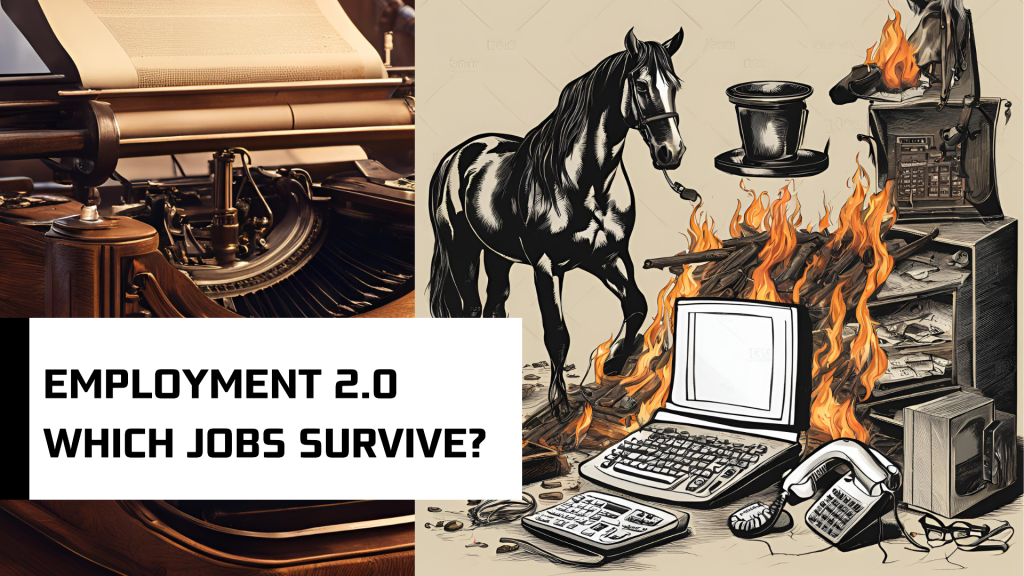
The barely (but probably not) understood nature of AI decision making means that the reigns of the horse are no longer held by human hands. While those who “own” AI technologies influence outcomes, they know they are far from being in control of outcomes. And this is new. Very new. For all of our history, people have controlled outcomes…but now, for the first time, we ceed power to forces that we dont (and will never be able to) understand.
AIs determining those who get hired and which markets thrive, doesnt only affect jobs, it’s about steering the future of decision-making itself.
In the next article I’ll dive deeper into how this shift could reshape not only our workplaces but also our societal fabric, impacting autonomy, opportunity, and equality on a global scale.