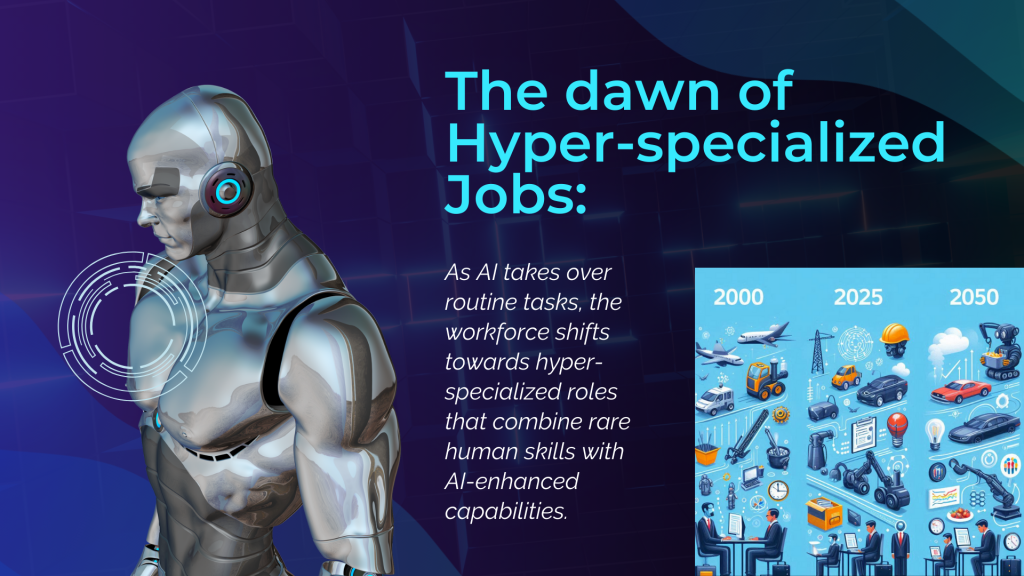
As AI takes over routine tasks, the workforce is shifting towards hyper-specialized roles that combine rare human skills with AI-enhanced capabilities.
The beginning of the end of “One-size-fits-all”?
In the age of AI, the concept of a “one-size-fits-all” job is fading rapidly. As artificial intelligence automates routine and repetitive tasks, it is simultaneously creating opportunities for hyper-specialized roles that require unique combinations of human traits, creativity, and AI-augmented skills. These emerging roles not only challenge traditional job structures but also represent a new frontier in employment, where individuals are valued for their niche expertise rather than their ability to perform standardized tasks.
Hyper-specialization is the natural progression of AI-driven economies. With machines handling data processing, basic decision-making, and administrative work, human workers are free to focus on complex, creative, and high-level decision-making activities. For instance, AI is revolutionizing fields like healthcare and pharmaceuticals by creating roles for AI-assisted bioinformatics specialists—professionals who combine their knowledge of biology with AI-driven data analytics to discover new drug compounds. Similarly, industries such as environmental science now require AI-powered sustainability consultants, who use AI to analyze environmental impact while providing human-led innovation in eco-friendly solutions.
Marrying human intuition with AI capabilities
Another example is the rise of AI-enhanced creative directors in the marketing and entertainment sectors. While AI may handle large-scale data analysis of consumer trends, the human creative director provides the irreplaceable emotional and cultural intelligence needed to design campaigns that resonate with audiences on a deep, personal level. This marriage of human intuition with AI capabilities allows for the development of content that is more targeted, personalized, and effective than ever before.
As AI tools become more ubiquitous, individuals with rare skills that complement AI will see their value in the job market skyrocket. Jobs that combine human strengths—such as empathy, ethics, and abstract problem-solving—with AI’s computational power will continue to grow in demand. For instance, AI-assisted ethicists are already becoming indispensable in sectors like autonomous vehicles and AI governance, where moral decision-making cannot be entirely left to algorithms.
This shift towards hyper-specialization is not without its challenges. Education systems and workforce training programs must adapt quickly to prepare individuals for roles that didn’t exist a few years ago. However, this new frontier also presents enormous opportunities. As AI augments human potential, it is creating jobs that are more personalized, fulfilling, and adaptable than traditional careers, offering a new and exciting chapter in the future of work.
Situational awareness…
1. AI-Assisted Bioinformatics Specialists in Drug Discovery (Insilico Medicine)
Insilico Medicine, a biotechnology company, is pioneering the use of AI in drug discovery. Its platform utilizes machine learning to analyze biological data and predict drug targets, drastically accelerating the research process. This has led to the creation of new hyper-specialized roles like AI-assisted bioinformatics specialists, who combine expertise in biology, genetics, and AI to design experiments, analyze massive datasets, and accelerate the discovery of novel compounds. These roles require a unique blend of domain-specific knowledge and AI skills, representing a clear example of hyper-specialization in a high-tech industry.
Source: Zhavoronkov, A., et al. (2019). Artificial intelligence for drug discovery, biomarker development, and generation of novel chemistry. Molecular Pharmaceutics, 16(7), 3106-3116.
2. AI-Powered Sustainability Consultants in Environmental Management (Google’s Environmental Insights Explorer)
Google’s Environmental Insights Explorer uses AI to analyze city-level data on emissions and energy use, enabling cities and businesses to make more informed decisions about sustainability. This tool has given rise to AI-powered sustainability consultants, professionals who work with local governments and corporations to develop eco-friendly policies and practices based on AI-driven insights. These roles require deep expertise in environmental science combined with the ability to work with advanced AI models, creating a hyper-specialized niche in sustainability management.
Source: Ghaffarzadegan, N., et al. (2020). AI in climate action: Opportunities and challenges. Climate Policy Journal, 20(8), 977-990.
3. AI-Enhanced Creative Directors in Marketing (Netflix’s AI-driven Content Personalization)
Netflix leverages AI for content recommendation and personalized marketing, creating a new role for AI-enhanced creative directors. These professionals use data insights generated by AI to tailor marketing campaigns, design content strategies, and create advertisements that resonate with highly specific audience segments. While the AI analyzes patterns in consumer behavior, the creative directors apply their human intuition and understanding of cultural nuances to ensure campaigns are emotionally engaging. This hybrid role is hyper-specialized, blending artistic vision with technical prowess in AI-driven marketing analytics.
Source: Smith, B., & Deighton, J. (2019). AI meets creativity: Exploring how artificial intelligence is reshaping marketing strategies. Journal of Marketing Analytics, 7(2), 123-137.