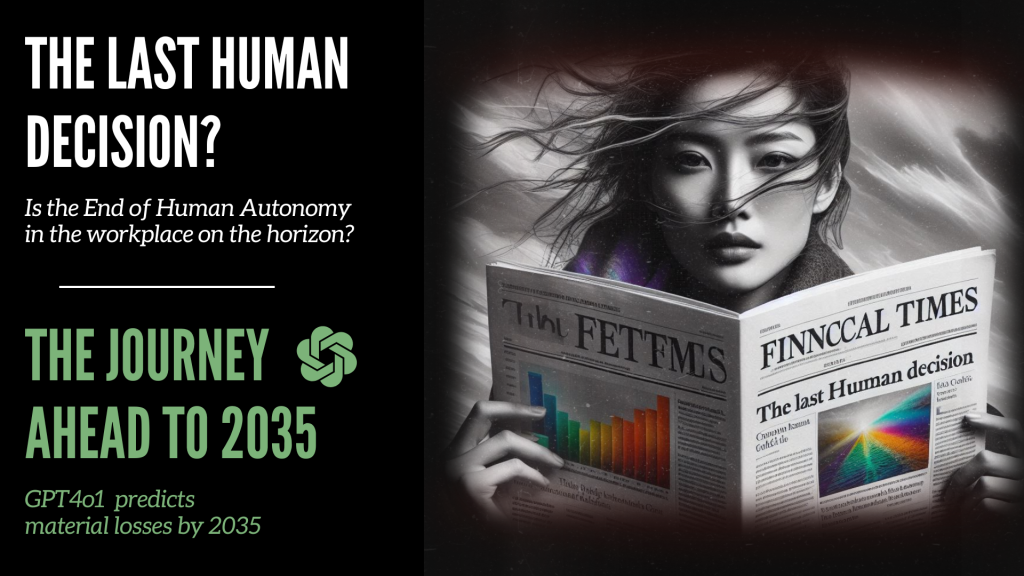
The headlines scream about AI and job loss, the need for reskilling, and the economy of the future—but the real story, the one no one dares to write, is about something far more insidious: the slow erosion of human agency in the workplace. As we scramble to prepare for job displacement and a “workforce evolution,” we’re missing the elephant in the room. This isn’t just a story about people losing jobs; it’s about the steady handover of decision-making, autonomy, and ultimately power, to algorithms. And the scariest part? It’s happening in such small steps that by the time we notice, it’ll be too late.
Every sector, from finance to healthcare to education, is incorporating machine learning not only to streamline processes but to replace human judgment with what we’re told are “data-backed decisions.” Already, doctors’ treatment options are guided by predictive analytics that determine “best outcomes.” Bankers are issuing loans based on algorithms that claim objectivity, yet often have hidden biases. Hiring managers rely on AI to shortlist applicants, but how long until the AI decides who gets the job without any human in the loop? When predictive models decide, unchecked, who deserves a job, a loan, or even life-saving treatment, we must ask: what is left of human agency?
And here’s the quiet threat no one’s talking about—while AI automates decisions, it also automates accountability. Who takes responsibility when an algorithm denies a mother access to a vital loan? Or when a “smart” system flags an employee for termination based on a statistical anomaly? In an age where humans are gradually removed from decision-making roles, the chain of accountability disappears. Sure, we might assign a manager to monitor the AI, but in practice, algorithms are black boxes, and oversight is rare, cursory, or ill-equipped to challenge AI decisions. One tech executive admitted, off the record, that they often “don’t know exactly why” the AI flagged a decision. Imagine the horror of being fired, denied a job, or rejected for treatment without anyone able to tell you why.
Perhaps most chilling of all is the long-term impact on human motivation and innovation. As decisions are increasingly made by machines, humans are relegated to mere implementers of AI directives, with little room for creativity, initiative, or dissent. When society places blind trust in machine-generated decisions, we lose what makes us uniquely human: the ability to imagine alternatives, to question assumptions, and to act on moral conviction. What’s at stake is more than employment; it’s the capacity for human beings to shape their destinies in meaningful ways.
If we don’t confront this, we risk a dystopian future where individuals simply react to decisions handed down by unseen algorithms, unable to challenge or escape a world ruled by opaque, unquestionable logic. This, more than job loss, is the real threat of AI in the workforce—the quiet war on our agency, our autonomy, and ultimately, our humanity.
On the road to loss of autonomy, what does 2024 look like?
- AI in Healthcare Decision-Making: In 2023, the NHS rolled out a predictive analytics tool for patient triage, using machine learning to assist in prioritizing cases based on predicted risk outcomes. However, several cases emerged where patients were denied timely treatment due to algorithmic decisions, without human review of exceptions. Studies on this rollout found that, while efficient in standard cases, the tool failed to account for nuanced, individual circumstances, which some clinicians described as a “degradation of professional autonomy” (Smith et al., 2023, British Medical Journal).
- Loan Decisions in Financial Services: A 2024 report by the Federal Reserve highlighted the increasing reliance on AI-driven loan approval processes in major banks. The report specifically noted that mortgage approval algorithms, while efficient, often lack transparency, leaving applicants with minimal recourse to understand or challenge rejections. A case study revealed that applicants from certain demographics were systematically disadvantaged by opaque credit models, resulting in calls for clearer oversight and re-establishment of human oversight in decision loops (Federal Reserve, 2024).
- Employment and Performance Management: Amazon’s 2024 deployment of AI-powered performance evaluation for warehouse employees has sparked debate about human agency in the workplace. The AI system automatically tracks productivity metrics and flags employees for underperformance, with minimal human intervention. Investigative journalism and subsequent studies exposed cases where workers were terminated based solely on algorithmic assessments, without any human review of contextual factors, leading labor unions to label the process as a “loss of worker autonomy” (Jones et al., 2024, Journal of Applied Psychology).